 />
/>Book Review: Women and Leadership in Distance Education in Canada
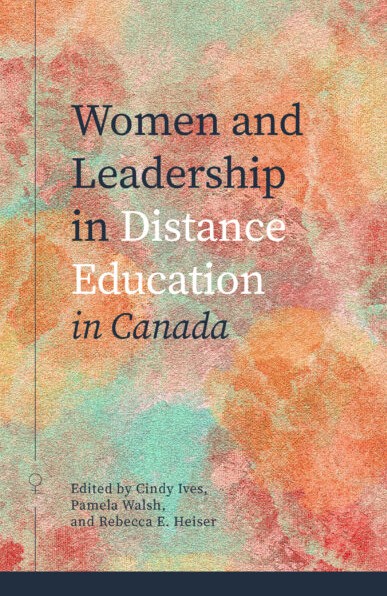
Edited by Cindy Ives, Pamela Walsh, and Rebecca E. Heiser. (2025). AU Press. 287 pages. https://doi.org/10.15215/aupress/9781771994439.01
ISSN: 2819-7046 - Volume 41, Issue 1, April 2026
https://doi.org/10.55667/10.55667/ijede.2026.v41.i1.1422
Edited by three women practitioners, scholars, and leaders in distance education in Canada, this volume brings together essays on women and leadership in the Canadian distance education context from a diverse array of contributors. Framed from an explicitly feminist and woman-centred perspective, the volume counters the historically inadequate documentation and understanding of women’s leadership in the Canadian higher education and distance education context, exploring the contributions and experiences of women leaders over approximately the last 40 years. The editors highlight the relative paucity of research addressing gender issues in distance education leadership and aim to address this gap by illuminating the systemic challenges faced by women leaders, including gender bias and power imbalances, as well as their distinctive contributions. The editors describe the stories in the volume as comprising a “previously uncharted but rich landscape of distance education” (p. 4), acknowledging that it builds on the previous work of Bainbridge and Wark (2023) and Kanwar et al. (2013).
The 19 essays in the volume are divided into three sections: Planning Learning, Communicating and Collaborating, and Reflecting on Experiences, with one contribution positioned between the editors’ introduction and the first section. The authors include instructional designers, faculty members, administrators, and students working and learning in distance education contexts across Canada; some are now retired, while others are early in their careers. Formal and informal leadership perspectives are well represented. The inclusion of Indigenous, immigrant, and racialized women’s voices, as well as those working in remote areas of Canada, adds depth and breadth to the collection.
The systemic challenges faced by women leaders past and present are evident in numerous stories. Sherry L. Rose and Kim Stewart highlight “conflicts with university timelines, grading policies, and workload responsibilities” (p. 99) in their creation of a distance education program in early childhood education deliberately designed to support women students and faculty members; they “struggle and often feel silenced” (p. 99) as women faculty members working in this space. Cynthia Eden, Natalie Green, Sandy Hughes, Victoria Kennedy, and Megan Pickard highlight the trivialization and dismissal of aesthetic details within instructional design as rooted in a perception of the aesthetic as the “feminine domain” (p. 53). Jenni Hayman explores the inequity in postsecondary and distance education in Canada, which “continue to be dominated by white male educators who earn more and are more likely to receive grants, publish research, and be rewarded with university tenure than equally qualified women and racialized educators” (p. 192). While Hayman acknowledges that open and distance education in Canada has “come a long way in terms of support and access for women,” she argues that “most [Canadian] colleges and universities still have a long way to go to establish themselves as places of authentic equity” (p. 193). Erin Keith builds on Hayman’s argument in her exploration of instructional leadership for adjunct (or casualized) academic staff in Canadian distance education, who include a disproportionate number of women and racialized faculty members and who face what Keith describes as “inequitable and unjust conditions” (p. 203). Afsaneh Sharif’s story of her journey in Canadian distance education highlights the additional challenges faced by racialized immigrant women in this context: the absence of a sense of belonging, a lack of representation in senior leadership, and experiences of microaggressions, exclusion, and racism. She describes the glass ceiling encountered by many women as “definitely lower [for her as a racialized woman], and … made not of glass but of concrete” (p. 227).
Despite the systemic challenges, the stories in the volume collectively describe a landscape in which women leaders have indelibly shaped Canadian distance education through their unique contributions and approaches to leadership. Lori Wallace sets the stage with her reflections on her 40-year career, highlighting the essential role that her collaboration with women leaders and colleagues has played across the decades and describing a relational, collective, and values-focused approach to leadership. Wallace’s description of her leadership approach is echoed by virtually every other story in the volume, from Amy Burns’ discussion of heart-led leadership to Jasmine Pham’s story of identity and community-building as an online graduate student and Levina (Connie) Yuen’s description of leadership as “serving others through guidance, knowledge sharing, and capacity building, with the primary aim of creating solidarity to achieve collective goals” (p. 247). Michelle Harrison, Christina Hendricks, Tannis Morgan, Anne-Marie Scott, and Elizabeth Childs describe the importance of “making time to slow down and take up a values-based leadership approach [which] can help us go further, faster, together” (p. 180). These women leaders have successfully guided Canadian distance education through rapid technological change (from paper-based courses distributed by mail to digital courses delivered over the Internet) and crises such as the COVID-19 pandemic. They have championed a student- and woman-centred approach to distance learning, centring justice and equity and leading decolonization in course and program design and in their institutions.
Overall, this volume is an essential contribution to the understanding of women and leadership in Canadian distance education and beyond and highlights the power of a narrative approach. Leaders, scholars, students, and practitioners will appreciate the practical wisdom and guidance offered throughout the stories and be inspired by the authors’ creativity, resilience, and commitment to the field of distance education and to the principle of access for structurally marginalized learners.
The collection lays a foundation for future work. The editors issue an explicit call to action in their introduction: “We recognize the need for ongoing dialogue and action focused on promoting values-based, inclusive, and socially just leadership” (p. 18), as well as the crucial importance of “identify[ing] and confront[ing] issues such as gender bias, racism, and other forms of discrimination that hinder inclusivity and justice” (p. 18). It is to be hoped that readers of this volume, having gained a deeper understanding of the issues, will respond meaningfully to this call.
References
Bainbridge, S., & Wark, N. (2023). The encyclopedia of female pioneers in online learning. Routledge.
Kanwar, A., Ferreira, F., & Latchem, C. (2013). Women and leadership in open and distance learning and development. Commonwealth of Learning. https://oasis.col.org/entities/publication/f9a03dfc-1336-43ce-9f79-45948144c8a0
Author
 https://orcid.org/0000-0002-3501-5240

This work is licensed under a Creative Commons Attribution 3.0 Unported License.